 Aayush Gupta
Outpatient clinicSeven days a week
Weekdays 9 a.m. to 5 p.m., with an evening clinic from 6 to 8 p.m. Saturdays 9 to 5, and Sundays and holidays 9 to 1.
Professor and Head, Department of Dermatology, Venereology and Leprology, Dr. D.Y. Patil Medical College, Hospital and Research Centre, Pune
He heads dermatology at Dr. D.Y. Patil, engineers scaffolds for skin repair in his Bioprinting Laboratory, and founded Qtanea Solutions, which makes the Vybe pain device and the OpenScholar research platform.

Including JAAD, the British Journal of Dermatology, JAMA Dermatology and The Lancet Public Health.
Principal investigator on industry studies from Phase 0 to Phase 4, including a Phase 3 leprosy trial.
In research grants from ANRF, DBT, ICMR and others, and a seed fund for Qtanea Solutions.
Granted in India and the United States, and a device company built on one of them.
Fifteen faculty and forty-five residents staff the dermatology department at Dr. D.Y. Patil Hospital in Pimpri, and they perform about 820 procedures a month.
Weekdays 9 a.m. to 5 p.m., with an evening clinic from 6 to 8 p.m. Saturdays 9 to 5, and Sundays and holidays 9 to 1.
About 390 a month in 2022 and about 820 a month in 2026, more than double. Each dot is ten procedures.
Fifteen residents join each year for the three-year MD, up from eleven. Eight hold ICMR thesis grants this year, up from three.


Hair reduction, tattoo and pigment removal, CO2 and erbium resurfacing, and photobiomodulation.
Vitiligo surgery, hair transplantation, radiofrequency surgery and skin biopsies with the department's patented punch.
Botulinum toxin, dermal fillers and intralesional steroid injections.
Chemical peels and medifacials for acne, pigmentation and ageing skin.
Body mapping, dermoscopy, hair counts, skin colour, ultrasound and sebum measured with calibrated instruments.
Psoriasis, vitiligo, eczema, acne, hair loss, leprosy, sexually transmitted infections and rare genetic skin disease, with phototherapy and excimer light on site.
Melanin, haemoglobin, tattoo ink and water each absorb a different band of light, so the wavelength decides which target a laser heats and how deep it works.
Narrowband ultraviolet B calms the T cells that drive both diseases and stimulates melanocytes, so that vitiligo patches repigment.


TrichoScan counts and measures every hair in a patch of scalp, and the DermaLab ultrasound probe reads skin thickness and density through the surface.


Seven research programmes run from the top of the skin to the bottom, from cameras that read the surface to scaffolds that rebuild the dermis.
Select a research programme to zoom into the skin and read what the studies found
Vitiligo skin carries a lower ultraviolet signature than non-melanoma skin cancers, and its epidermis shows a strong anti-skin cancer signature in miRNA networks. The long noncoding RNA MALAT1 and the microRNA miR-31-5p both protect melanin-deficient vitiligo keratinocytes against ultraviolet damage to DNA. An ANRF grant now funds an immune-competent 3D human skin model of vitiligo.
Dr Gupta is the principal investigator on all seven, for sponsors that include Johnson & Johnson, Pfizer, Sun Pharma and Ahammune Biosciences.
Deuruxolitinib
Submitted to DCGI
A Double-Blind, Randomized, Placebo-Controlled Multicenter Study to Evaluate the Efficacy and Safety of Deuruxolitinib in Adolescent Patients with Severe Alopecia Areata with an Open-Label Extension Period
Skin assessment chart and plasma PGL-I
Opens October 2026
A Phase 0, Clinical Study to Provide Fit-For-Purpose Evidence for the Standardized Skin Assessment Chart and to Evaluate Changes in Plasma Phenolic Glycolipid-I Over Time for Treatment Monitoring in Multibacillary Leprosy Patients
Topical AB1001
Opens October 2026
A Phase II, multicenter, randomized study to evaluate safety and efficacy of topical AB1001 in adult patients with non-segmental vitiligo
H-Vit hair serum
Opens October 2026
An Open Label, Prospective, Single Arm Observation Study on H-Vit Hair Serum of Systopic Laboratories Pvt. Ltd. in Adults Looking to Improve Hair Health in Real World Clinical Practice
Guselkumab, subcutaneous
Opens November 2026
A Phase IV, Multicenter, Non-comparative, Open-Label Study Evaluating the Safety and Efficacy of Guselkumab Administered Subcutaneously in the Treatment of Indian Patients with Psoriasis (CNTO1959PSO4039)
Bedaquiline with rifampicin and clofazimine (LIGHT)
Under way since January 2025
A Phase 3, Multicenter, Open-label, Rater-blind, Active-controlled Study to Evaluate the Efficacy and Safety of Bedaquiline for the Treatment of Multibacillary Leprosy When Combined With Rifampicin and Clofazimine [LIGHT]
Immuno-dermatology disease registry
Started March 2025, completed
An Immuno-Dermatological Disease Registry to Understand the Burden of Atopic Dermatitis (AD), Alopecia Areata (AA), and Vitiligo in Indian Patients
Dr Gupta has led nine extramural research projects funded by ANRF, DBT, ICMR, CSIR-IGIB, IADVL and industry, and Qtanea Solutions holds a ₹50 lakh seed fund.
Qtanea Solutions makes Vybe for injection pain and OpenScholar for university research reporting, and the Department of Biotechnology funds the scaffold work in the Bioprinting Laboratory.

Vybe vibrates the skin during an injection so that the patient feels less pain. In a split-lesion study published in Dermatologic Surgery, vibration-assisted anaesthesia reduced pain during dermatologic procedures.
Read the studyOpenScholar, also known as RIMS, is the research information platform Qtanea Solutions makes for universities. It imports every paper from PubMed and ORCID, tracks h-index and citations, and prepares the publication figures used for NIRF and QS rankings. Dr. D.Y. Patil Vidyapeeth runs its research reporting on it.
openscholar.in
The laboratory develops injectable granular hydrogels for skin tissue engineering. A DBT grant funds an automated device that sprays a bioscaffold carrying the patient's own cells.
Read the hydrogel paperDr Gupta is first or senior author on 64 of them, and his papers appear in The Lancet Public Health, JAMA Dermatology, the British Journal of Dermatology and the Journal of the American Academy of Dermatology.
Two awards from the National Academy of Medical Sciences, the Lokmat Dhanvantri Award, two journal awards and a science fellowship in Japan.
Dr Gupta has lectured at the National Academy of Medical Sciences in Jaipur, been honoured at ROOTS in Pune and attended the QS Higher Ed Summit at Korea University in Seoul.
Short animated films that explain common skin problems and their treatment, in English and Hindi, each checked and approved by Dr Gupta.
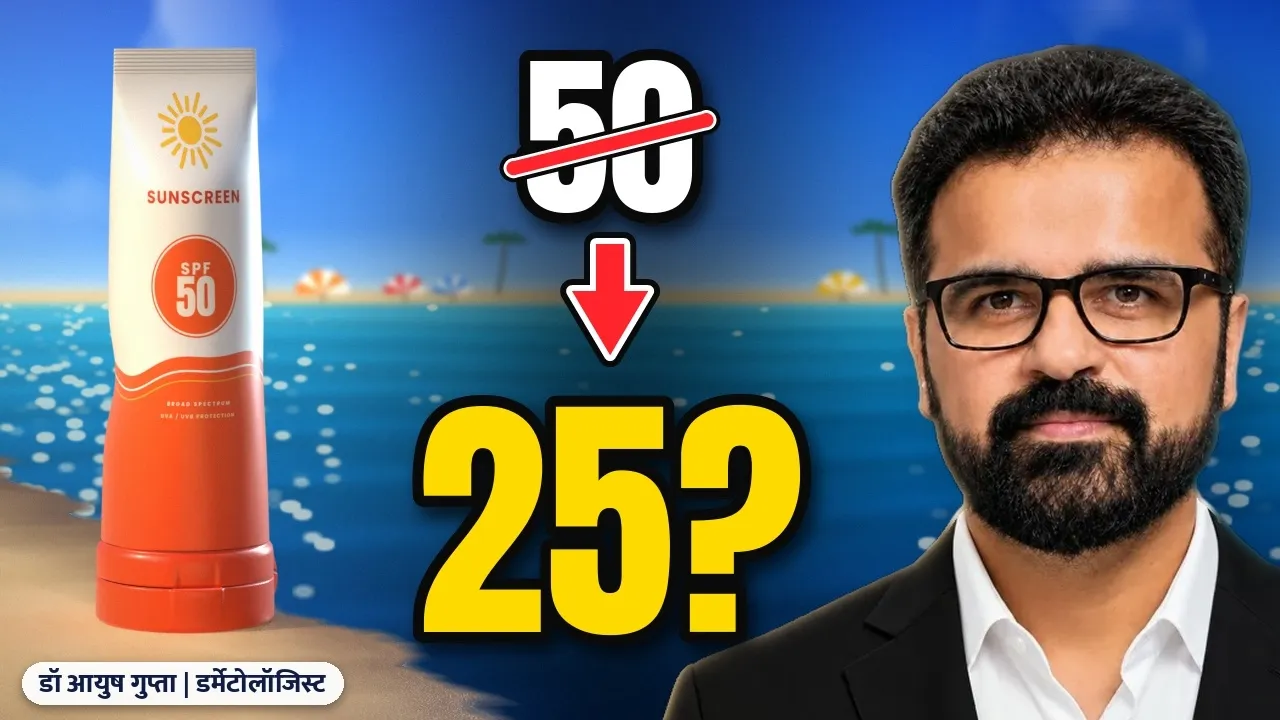
Zyadatar log utni sunscreen ki aadhi lagate hain jitni SPF test mein use hoti hai, ya usse bhi kam. Yeh film dikhati hai ki itni patli layer tube par likhe protection ko kitna ghatati hai. SPF test mein skin ke har square centimetre par 2 mg cream lagayi jati hai. Aadhi cream lagane par SPF zyada se zyada lagbhag aadha rehta hai, aur kai studies mein isse kaafi kam mila. Ooncha SPF is kami ka kuch hissa bharta hai, par sirf wahin jahan cream lagi ho. Film ke aakhir mein chehre aur gardan ke liye kitni cream lagani hai, aur apni tube jaanchne ka ek aasaan tareeka hai.
26 October 2026 · 5 chapters · 11 sources
 English · 3 minWhat SPF 30 Really Means24 October 2026
 Hindi · 4 minSPF 30 का असल मतलब क्या है?19 October 2026
 English and Hindi · 2 minIs Your ‘Magic Cream’ Secretly a Steroid?14 October 2026
All explainer films Subscribe on YouTube
General health education, not medical advice for any individual. Narration uses an AI voice; the script and animation are prepared with AI assistance, then checked and approved by Dr Gupta.
Dr Gupta takes on expert calls, advisory board seats and reviews of trial protocols and devices for companies, investors and universities. Write to aayushggupta@gmail.com or use the form.
The questions people ask most often, each answered in a few lines.
Aayush Gupta is Professor and Head of the Department of Dermatology, Venereology and Leprology at Dr. D.Y. Patil Medical College, Hospital and Research Centre, Dr. D.Y. Patil Vidyapeeth, Pimpri, Pune. He is Director of Strategic Initiatives at the medical college, heads the Bioprinting Laboratory of Dr. D.Y. Patil Vidyapeeth and directs the MD dermatology residency programme. He founded Qtanea Solutions Private Limited, which makes Vybe, a vibratory anaesthesia device, and OpenScholar, a research information platform for universities, and he holds five patents in India and the United States. He has published 102 papers, is principal investigator on seven industry clinical trials and has raised nearly ₹7.5 crore for research, made up of nine extramural research grants and a ₹50 lakh seed fund for his company Qtanea Solutions. His research covers vitiligo, ichthyosis and other genodermatoses, leprosy, wound healing and imaging with artificial intelligence.
Vybe is a vibratory anaesthesia device made by Qtanea Solutions, the company Dr Gupta founded. It vibrates the skin during an injection so that the patient feels less pain. In a split-lesion study published in Dermatologic Surgery, vibration-assisted anaesthesia reduced pain during dermatologic procedures.
OpenScholar, also known as RIMS, is a research information platform made by Qtanea Solutions, the company Dr Gupta founded. It imports a university's papers from PubMed and ORCID, tracks h-index and citations, builds a profile page for each researcher and prepares the publication figures used for NIRF and QS rankings. Dr. D.Y. Patil Vidyapeeth runs its research reporting on OpenScholar.
Dr Gupta holds five granted patents. Three of them, US 11,523,738 and Indian patents 323440 and 564943, are assigned to Adiuvo Diagnostics and protect devices that detect pathogens and other cells. Indian patent 559407 protects a punch biopsy instrument, and Indian patent 499691 protects the pain-abating device on which Vybe is built.
Dr Gupta is the principal investigator on seven industry studies at Dr. D.Y. Patil. LIGHT, a Phase 3 Johnson & Johnson trial of bedaquiline in multibacillary leprosy, has been under way since January 2025, and a Pfizer registry of atopic dermatitis, alopecia areata and vitiligo is complete. Four studies open in October and November 2026: a Phase 0 Johnson & Johnson study of plasma PGL-I in leprosy, a Phase 2 study of topical AB1001 in vitiligo for Ahammune Biosciences, an observational study of H-Vit hair serum for Systopic Laboratories and a Phase 4 study of guselkumab in psoriasis for Johnson & Johnson. A Sun Pharma trial of deuruxolitinib in adolescents with severe alopecia areata awaits DCGI approval.
Dr Gupta has raised nearly ₹7.5 crore for research, made up of nine extramural research projects and a ₹50 lakh seed fund for Qtanea Solutions. The largest is a ₹3 crore Anusandhan National Research Foundation grant, with IIT Kanpur, to develop switchable bispecific BCMA/CD19 CAR-T cell therapy for refractory systemic lupus erythematosus. DBT funds an automated device that sprays a bioscaffold carrying the patient's own cells, and a second DBT grant from December 2026 will test non-viral transglutaminase-1 delivery for congenital ichthyosis. ICMR funds a Skin-on-Chip platform for cosmetic endocrine disruptors, and ANRF funds an immune-competent 3D skin model of vitiligo. Earlier grants came from ICMR, CSIR-IGIB, IADVL and Adiuvo Diagnostics.
The outpatient clinic of the Department of Dermatology, Venereology and Leprology at Dr. D.Y. Patil Medical College, Hospital and Research Centre in Pimpri, Pune, is open from 9 a.m. to 5 p.m. and again from 6 to 8 p.m. on weekdays, from 9 a.m. to 5 p.m. on Saturdays, and from 9 a.m. to 1 p.m. on Sundays and holidays. The department has fifteen faculty and forty-five residents and performs about 820 procedures a month.
Yes. He advises companies, investors and universities on dermatology drugs, clinical trials at Indian sites, dermatology devices and diagnostics, rare genodermatoses and research information systems. Enquiries can be sent through the form on this page.