 Aayush Gupta
Are You Getting Even Half Your SPF?
The share of the labelled SPF that a thin layer of sunscreen delivers, and the amount dermatologists advise for the face and neck.
Chapters
- 0:00 How SPF is measured
- 0:13 Protection from half the cream
- 0:32 Thin SPF 50 against thin SPF 30
- 0:55 How much to apply and when to reapply
- 1:13 Checking your own tube
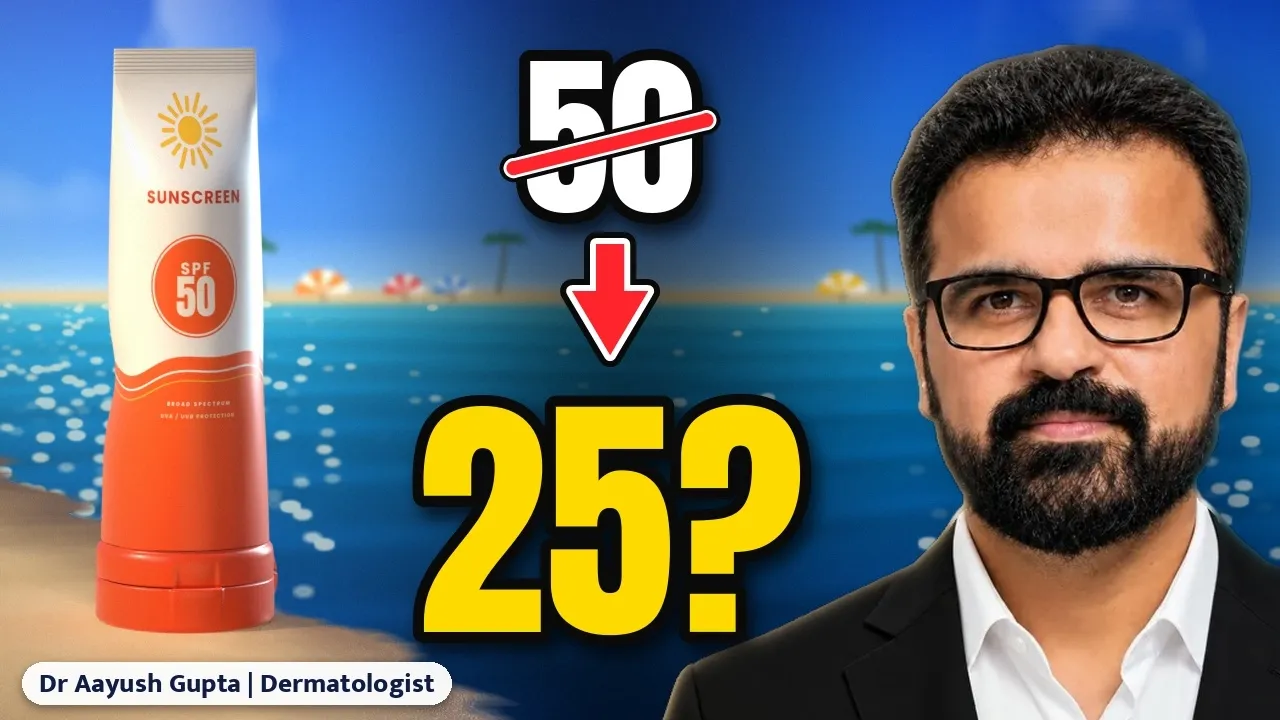
Most people spread half the sunscreen that the SPF test uses, or less. This film shows what that thinner layer does to the protection printed on the tube. The SPF test puts 2 mg of cream on every square centimetre of skin. Half that amount gives at most about half the SPF, and most studies that measured it found a larger fall. A higher SPF makes up for part of the loss, but only on skin the cream reaches. The film ends with how much to apply to the face and neck, and a simple check of your own tube.
- Topic
- Sunscreen amount and the SPF a thin layer delivers
- Reviewed by
- Dr Aayush Gupta
- Published
- 29 October 2026
- Languages
- English and Hindi
- Related research
- Vitiligo and pigment biology
- On YouTube
- Watch on YouTube ↗
The explanation
Laboratories measure the sun protection factor (SPF) on a sunscreen label with 2 mg of product on each square centimetre of skin (21 CFR 201.327). People observed in everyday use, mostly on beaches, applied between 0.39 and 1.0 mg/cm², one fifth to one half of that amount (Petersen and Wulf, 2014).
SPF at thinner layers
Faurschou and Wulf applied an SPF 4 sunscreen at several thicknesses in 20 volunteers, and its SPF most likely fell exponentially (Faurschou and Wulf, 2007). Schalka and colleagues reported the same exponential pattern for SPF 15 and SPF 30 sunscreens in a larger group of 40 (Schalka et al., 2009). An exponential fall was also the most likely fit in 15 people with Asian skin (Kim et al., 2009).
Liu and colleagues found that SPF 30 and SPF 55 sunscreens lost their SPF exponentially, whereas SPF 4 and SPF 15 sunscreens lost it linearly (Liu et al., 2012). In a study run at three test centres, Bimczok's group found that the SPF changed in a straight line with the applied amount from 0.5 to 2.0 mg/cm² (Bimczok et al., 2007). Couteau and colleagues showed that halving the amount of a cream or oil divided its ultraviolet A (UVA) protection factor by 2.2 on average (Couteau et al., 2016).
SPF 50 and SPF 30 at the same thin layer
The exponential model predicts a delivered SPF equal to the labelled SPF raised to the power d/2, where d is the applied amount in mg/cm² (Faurschou and Wulf, 2007). At 1 mg/cm², this formula gives an SPF 50 sunscreen a delivered SPF of about 7 (50 to the power 0.5), against about 5.5 for SPF 30 (30 to the power 0.5). Although SPF 50 keeps the higher value, its delivered SPF is about 14% of the labelled 50 (7 divided by 50). For SPF 30, the delivered 5.5 is about 18% of the labelled 30 (5.5 divided by 30).
Liu and colleagues concluded that users may receive a lower SPF than they expect from high-SPF sunscreens (Liu et al., 2012). Petersen and Wulf cite evidence that early reapplication, or very high SPF sunscreens of 70 to 100, may partly make up for a thin layer (Petersen and Wulf, 2014).
Amount advised for the face and neck
The Indian Sunscreen Forum advises 1 to 2 teaspoons of sunscreen for the face and neck (Kohli et al., 2025). Its panel reached that advice by a modified Delphi process, in which experts rate statements over repeated rounds (Kohli et al., 2025). Glenmark Pharmaceuticals supported the work through an unrestricted educational grant, and four of the 18 authors are its employees (Kohli et al., 2025).
Reapplication and skin coverage
Sunscreen labels in the United States tell users to reapply at least every 2 hours (21 CFR 201.327). The Indian consensus notes that many public health agencies advise reapplying every 2 to 3 hours, mainly to offset thin layers and loss through activity (Kohli et al., 2025). Its own panel judged reapplication within 8 hours unnecessary once the recommended amount is on, unless swimming, sweating or rubbing removes the sunscreen (Kohli et al., 2025).
Petersen and Wulf proposed that patients apply sunscreen before going into the sun and once more within the first hour (Petersen and Wulf, 2014). In Heerfordt's study, about 20% of exposed skin stayed uncovered after one application, and a second coat reduced that share to about 9% (Heerfordt, 2018).
Daily amount from a 50 g tube
A teaspoon holds 5 mL, which weighs about 5 g for a cream with a density close to 1 g/mL. At 5 g a day, a 50 g tube lasts about ten days on the face and neck. If the same 50 g lasts 90 days, daily use falls to about 0.56 g (50 divided by 90). The 1 to 2 teaspoons that the Indian Sunscreen Forum advises hold 5 to 10 g (Kohli et al., 2025), so 0.56 g is roughly one ninth to one eighteenth of that amount.
Sources
- US Code of Federal Regulations, 21 CFR 201.327 (the SPF test uses 2 mg/cm² of sunscreen; US labels say to reapply at least every 2 hours). ecfr.gov
- Petersen B, Wulf HC. Photodermatol Photoimmunol Photomed 2014 (people apply about 0.39 to 1.0 mg/cm²; very high SPF may partly make up for applying too little). doi:10.1111/phpp.12099
- Faurschou A, Wulf HC. Br J Dermatol 2007 (in 20 volunteers using an SPF 4 sunscreen, protection most likely fell exponentially as less was applied). doi:10.1111/j.1365-2133.2006.07684.x
- Schalka S et al. Photodermatol Photoimmunol Photomed 2009 (SPF 15 and SPF 30 fell exponentially with the amount applied). doi:10.1111/j.1600-0781.2009.00408.x
- Kim SM et al. J Am Acad Dermatol 2009 (in 15 volunteers with Asian skin, the SPF fell as less was applied, most likely exponentially). doi:10.1016/j.jaad.2009.06.047
- Liu W et al. Photodermatol Photoimmunol Photomed 2012 (SPF 30 and 55 fell exponentially with thinner layers, SPF 4 and 15 in a straight line). doi:10.1111/j.1600-0781.2012.00650.x
- Bimczok R et al. Skin Pharmacol Physiol 2007 (the SPF changed in a straight line with the amount applied, from 0.5 to 2.0 mg/cm² in three test centres). doi:10.1159/000096173
- Couteau C et al. Int J Pharm 2016 (UVA protection was divided by 2.2 on average when the amount was halved). doi:10.1016/j.ijpharm.2016.01.041
- Kohli M et al. J Cosmet Dermatol 2025, Indian Sunscreen Forum consensus (1 to 2 teaspoons for the face and neck; the paper notes that many public health agencies advise reapplying every 2 to 3 hours, while the panel itself says reapplication within 8 hours is unnecessary unless swimming, sweating or rubbing removes the sunscreen). doi:10.1111/jocd.70441
- Heerfordt IM. Dan Med J 2018 (applying sunscreen twice left about 9% of exposed skin uncovered, against about one fifth after one application). pubmed.ncbi.nlm.nih.gov
- The figure of about 3 rays in 100 for a properly applied SPF 30 is 1 divided by the SPF. The ten days for a 50 g tube assume one teaspoon, about 5 mL, a day and a cream density of about 1 g/mL. At the same thin layer, every relation above keeps an SPF 50 sunscreen's effective SPF above an SPF 30's.
Transcript
Read the full narration
Think of sunscreen as an umbrella you open before the rain. The SPF 30 on this tube was measured with that umbrella fully open, two milligrams of cream on every square centimetre of skin. In real use, people spread about half of that, or less. What happens when the umbrella is made of cloth half as thick?
Half the cream gives you half the SPF at best, and in most studies much less. In laboratory tests, protection from UVA rays also fell to less than half.
A stronger umbrella makes up for part of the loss. Of a hundred burning rays, a properly applied SPF 30 lets about three in. Spread thin, it lets in more, and an SPF 50 spread just as thin lets in fewer than that thin SPF 30. A higher SPF only works where the cream is, so cover every part of the face and neck.
A group of Indian dermatologists advises one to two teaspoons of sunscreen for the face and neck. Putting on a second coat leaves fewer patches of skin uncovered. Many health agencies recommend topping up every two to three hours outdoors, and again after swimming, sweating or towelling.
At one teaspoon a day, a fifty gram tube lasts about ten days. If yours lasts for months when used every day, you are probably using a fraction of a teaspoon.
Tonight, fill a teaspoon with your sunscreen and hold it beside your usual dab. Send this film to anyone whose tube lasts for months. The next film asks how much sun still reaches you in the shade, behind glass and under clouds.
More explainers

General health education, not medical advice for any individual. Narration uses an AI voice; the script and animation are prepared with AI assistance, then checked and approved by Dr Gupta.