 Aayush Gupta
Is Your ‘Magic Cream’ Secretly a Steroid?
How a topical steroid calms the face, why the redness returns worse, and how to recognise a steroid from the name on the tube.
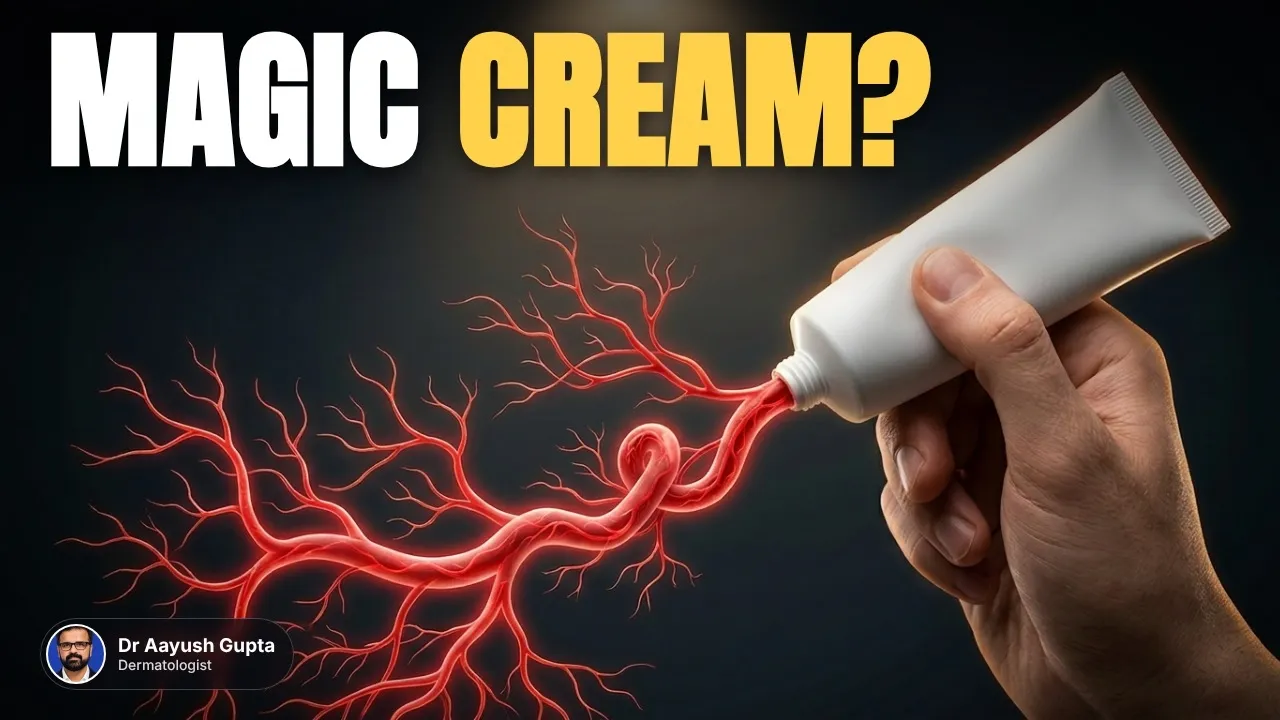
Chapters
- 0:00 The hook, why people start it
- 0:16 What a topical steroid is
- 0:29 1 Calms, 2 Narrows vessels
- 0:42 The rebound flare
- 0:56 3 Quiets immune guards
- 1:06 Steroid acne
- 1:18 4 Thins skin, dependence
- 1:39 Read your label
- 1:55 The way out
A cream can clear the redness on your face quickly, and yet the redness may come back stronger once the tube runs out. This film explains why, by following four effects of a topical steroid on the skin: calming inflammation, narrowing blood vessels, quieting the skin's immune defences, and thinning the skin. It also shows how dependence on the cream can develop and how the ingredient names on a tube label identify a steroid.
- Topic
- Topical steroid damaged face
- Reviewed by
- Dr Aayush Gupta
- Published
- 14 October 2026
- Languages
- English and Hindi
- On YouTube
- Watch on YouTube ↗
The explanation
Topical corticosteroids are one of the most widely prescribed classes of topical drug, and they give rapid relief in almost every inflammatory dermatosis (Pal et al., 2018). On the face, the same speed of relief allows misuse to continue for months without medical review. This page accompanies a two-minute film for patients and sets out the evidence behind each statement in it, so that a clinician who shows the film to a patient knows where each point comes from.
How facial use begins
Patients rarely begin facial steroid use on a dermatologist's advice. In a study of 200 patients who had used topical corticosteroids on the face for at least a month, pharmacists had advised 34.5% of them, friends and relatives 30.5% and non-dermatology physicians 15%, whereas dermatologists had advised only 9% (Sharma et al., 2017). In the same study, 36% used the cream as a fairness or general-purpose cream, and others used it for acne or for melasma and pigmentation. Melasma and hyperpigmentation were also the main concern of patients aged 30 to 39 years in an eastern Indian series, in which 83.8% of 271 users did not know that topical steroids could have side effects (Pal et al., 2018). The lightening that patients seek is real but temporary, since steroids may reduce melanocyte activity and the hypopigmentation usually reverses after withdrawal (Coondoo et al., 2014).
Four actions on the skin
Topical corticosteroids act on the skin through four principal effects: they suppress inflammation, constrict dermal vessels, depress local immunity and inhibit cell proliferation (Niculet et al., 2020).
The anti-inflammatory effect suppresses erythema and inflammatory lesions at first, although flares follow when the cream is stopped (Coondoo et al., 2014). Vasoconstriction narrows the superficial vessels, which dilate again afterwards; after prolonged use the dilatation persists and becomes conspicuous in thinned skin. One proposed mechanism is that chronic use inhibits endothelial nitric oxide, which accumulates and is released on withdrawal to produce erythema, itching and burning. However, the same review describes the evidence for this role as inconclusive (Maskey et al., 2025).
Local immunosuppression impairs the defence against dermatophytes, so that a fungal infection can persist or extend while the rash appears to improve, which is the picture of tinea incognito (Coondoo et al., 2014). Steroid acne presents as monomorphic inflammatory papules and pustules with few or no comedones (Coondoo et al., 2014). It is thought to arise when the steroid degrades the follicular epithelium and the follicular contents spill into the dermis (Maskey et al., 2025). Corticosteroids also inhibit fibroblast proliferation and collagen synthesis, so the dermis thins (Niculet et al., 2020). The small vessels then lose their dermal support, and telangiectasia becomes visible, particularly on the face.
Dependence
With repeated use the skin becomes less responsive, a phenomenon called tachyphylaxis, and patients move to more potent preparations that carry more severe adverse effects (Coondoo et al., 2014). Patients who develop acne, rosacea-like erythema or telangiectasia often continue the cream because they fear a flare on withdrawal. After long-term use, attempted withdrawal can produce a burning, red and scaly face, termed topical steroid dependent face, and the condition can become worse than it was before the cream was first applied (Maskey et al., 2025).
Reading the label
The stems of the WHO International Nonproprietary Names allow a patient to recognise a steroid from the label (World Health Organization, 2018/stembook-2018.pdf)). Names ending in -sone (betamethasone, mometasone, clobetasone, fluticasone), -olone (triamcinolone, fluocinolone) and -onide (fluocinonide, desonide) belong to corticosteroids, and "cort" in a name, as in hydrocortisone, marks one as well. Clobetasol belongs to the -betasol group and is classed among the potent and very potent preparations (Pal et al., 2018). Steroid creams are often combined with an antibiotic, an antifungal, salicylic acid or a retinoid (Coondoo, 2014), so a combination product can still contain a steroid.
Withdrawal
Withdrawal plans usually combine supportive care for physical and psychological symptoms with gradual tapering of the steroid before it is stopped completely (Maskey et al., 2025). Atrophy can recover after the steroid is stopped, although recovery may take months (Coondoo et al., 2014). The film therefore directs patients to a dermatologist for a supervised taper.
Sources
- Coondoo A Indian J Dermatol 2014. doi:10.4103/0019-5154.139870
- Coondoo A et al. Indian Dermatol Online J 2014. doi:10.4103/2229-5178.142483
- Maskey AR et al. Front Allergy 2025. doi:10.3389/falgy.2025.1547923
- Niculet E et al. Clin Cosmet Investig Dermatol 2020. doi:10.2147/CCID.S224211
- Pal D et al. Indian J Dermatol 2018. doi:10.4103/ijd.IJD_218_17
- Sharma R et al. J Dermatol Case Rep 2017. doi:10.3315/jdcr.2017.1240
- World Health Organization The use of stems in the selection of International Nonproprietary Names (INN) for pharmaceutical substances (WHO/EMP/RHT/TSN/2018.1) 2018. cdn.who.int
Transcript
Read the full narration
A cream clears the redness on your face, fast. Then the tube runs out, and the redness comes back worse. Why?
Many start it for melasma, brown cheek patches, or to look fairer. The cream can lighten skin, for a while.
That cream is a topical steroid, among the most widely prescribed skin creams. Yet in one study, most users did not know it could have side effects. What does it do to your skin? Four things.
First, it calms inflammation, the skin's swelling and redness, which can feel like magic.
Second, it narrows blood vessels, called vasoconstriction, leaving less red showing.
When the cream stops, the vessels rebound and widen. One proposed cause is nitric oxide, a vessel-widening chemical that builds up, then floods out. After long use, that is the red, burning flare.
Third, it quiets your skin's immune guards. A fungal infection can spread underneath while the rash looks better: tinea incognito, ringworm in disguise.
It can also bring steroid acne: monomorphic, meaning small, identical bumps. The steroid is thought to break down each hair follicle's lining, so they spill and flare together.
Fourth, it slows fibroblasts, the cells that knit collagen, the skin's support mesh. The skin thins, showing fine vessels.
Over time skin may respond less, called tachyphylaxis, so stronger creams follow, and fear of the flare keeps people going. That is topical steroid dependent face.
Turn your tube over. Steroid names usually end in sone, olone or onide, or contain cort. Watch for betasol, as in clobetasol, a very strong steroid. Many contain an antifungal or antibiotic.
If you find one, a dermatologist can plan a gradual taper. Thinned skin can recover, though it may take months.
Send this to the friend whose cream works like magic.
More explainers
General health education, not medical advice for any individual. Narration uses an AI voice; the script and animation are prepared with AI assistance, then checked and approved by Dr Gupta.