 Aayush Gupta
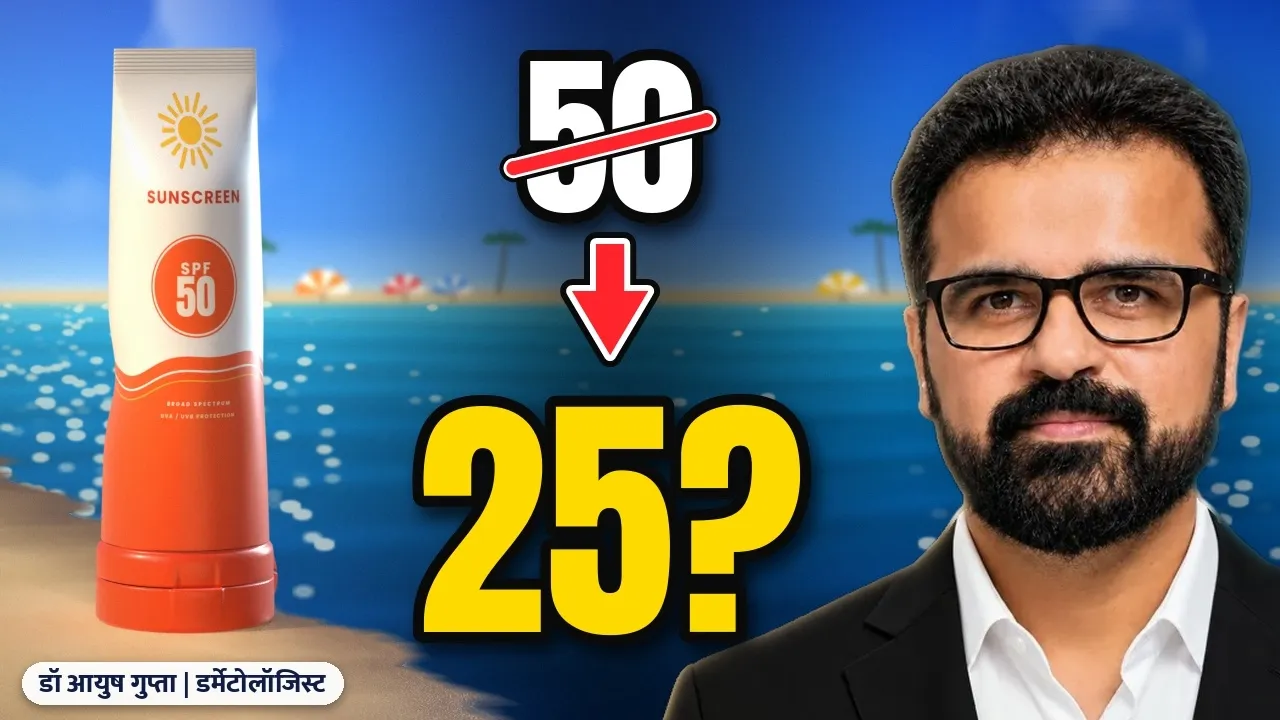
क्या आपको आधा SPF भी मिल रहा है?
How much of the labelled SPF a thin layer of sunscreen delivers, how far a higher SPF offsets the loss, and how much to apply to the face and neck.
Chapters
- 0:00 SPF kaise naapte hain
- 0:16 Aadhi cream se kitna protection
- 0:38 Patla SPF 50 aur patla SPF 30
- 1:08 Kitni lagayein aur kab dobara
- 1:32 Apni tube check kijiye
Zyadatar log utni sunscreen ki aadhi lagate hain jitni SPF test mein use hoti hai, ya usse bhi kam. Yeh film dikhati hai ki itni patli layer tube par likhe protection ko kitna ghatati hai. SPF test mein skin ke har square centimetre par 2 mg cream lagayi jati hai. Aadhi cream lagane par SPF zyada se zyada lagbhag aadha rehta hai, aur kai studies mein isse kaafi kam mila. Ooncha SPF is kami ka kuch hissa bharta hai, par sirf wahin jahan cream lagi ho. Film ke aakhir mein chehre aur gardan ke liye kitni cream lagani hai, aur apni tube jaanchne ka ek aasaan tareeka hai.
- Topic
- How much sunscreen to apply and how much SPF a thin layer gives
- Reviewed by
- Dr Aayush Gupta
- Published
- 26 October 2026
- Languages
- Hindi
- Related research
- Vitiligo and pigment biology
- On YouTube
- Watch on YouTube ↗
The explanation
The SPF printed on a sunscreen label is measured at 2 mg/cm² (21 CFR 201.327). In studies of real-world use, which were mostly carried out at beaches, people applied about 0.39 to 1.0 mg/cm² (Petersen and Wulf, 2014). That range is one fifth to one half of the test amount, so people in these studies received less protection than the labelled SPF indicates.
SPF at thinner layers
The measured SPF most likely fell exponentially with the applied amount in 20 volunteers who used an SPF 4 sunscreen (Faurschou and Wulf, 2007). Schalka and colleagues found exponential falls for SPF 15 and SPF 30 products in 40 volunteers (Schalka et al., 2009). A study of 15 volunteers with Asian skin found the fall most likely to be exponential as well (Kim et al., 2009).
However, Liu and colleagues found exponential falls only for SPF 30 and SPF 55 products, whereas SPF 4 and SPF 15 products fell in a straight line (Liu et al., 2012). In addition, three test centres found a straight-line relation between 0.5 and 2.0 mg/cm² (Bimczok et al., 2007).
In the exponential model, the delivered SPF equals the labelled SPF raised to the power d/2, where d is the applied amount in mg/cm² (Faurschou and Wulf, 2007). An SPF 30 sunscreen spread at 1 mg/cm² then gives an SPF of about 5.5. In one study, halving the amount divided the UVA protection factor by 2.2 on average, with differences between creams and oils and between SPF levels (Couteau et al., 2016).
SPF 50 and SPF 30 at a thin layer
By the same calculation, an SPF 50 product spread at 1 mg/cm² gives an SPF of about 7, against about 5.5 for an SPF 30 product spread equally thinly. The SPF 50 product keeps about 14% of its labelled value at that layer and the SPF 30 product about 18%. Liu and colleagues concluded that consumers may obtain even lower than expected protection from high SPF products (Liu et al., 2012). A review by Petersen and Wulf cites evidence that early reapplication may partly compensate for thin application, as may very high SPF products of 70 to 100 (Petersen and Wulf, 2014).
Amount for the face and neck
The Indian Sunscreen Forum reached a modified Delphi consensus, a method in which experts rate statements over repeated rounds, and it recommends 1 to 2 teaspoons for the face and neck (Kohli et al., 2025). Four of its 18 authors are employees of Glenmark Pharmaceuticals, which supported the work through an unrestricted educational grant (Kohli et al., 2025). The paper notes that many public health agencies advise reapplying every 2 to 3 hours, mainly to offset under-application and removal by activity (Kohli et al., 2025). Its panel considers reapplication within 8 hours unnecessary if the recommended amount was applied at the start, with an exception when swimming, sweating or rubbing removes the sunscreen (Kohli et al., 2025).
Reapplication and coverage
United States labels instruct users to reapply at least every 2 hours (21 CFR 201.327). Petersen and Wulf proposed teaching patients to apply sunscreen before sun exposure and to reapply once within 1 hour (Petersen and Wulf, 2014). A second application improves coverage; two applications left about 9% of exposed skin uncovered, against about 20% after one (Heerfordt, 2018).
A home check of the amount
A standard teaspoon holds 5 mL, which weighs about 5 g for a cream with a density close to 1 g/mL. One teaspoon a day thus empties a 50 g tube in about ten days. A 50 g tube used on the face and neck that lasts 90 days delivers about 0.56 g a day, which is roughly one ninth to one eighteenth of the 5 to 10 g in 1 to 2 teaspoons.
Sources
- (Same list as the English film.)
- 21 CFR 201.327. ecfr.gov
- Petersen B, Wulf HC. Photodermatol Photoimmunol Photomed 2014. doi:10.1111/phpp.12099
- Faurschou A, Wulf HC. Br J Dermatol 2007. doi:10.1111/j.1365-2133.2006.07684.x
- Schalka S et al. Photodermatol Photoimmunol Photomed 2009. doi:10.1111/j.1600-0781.2009.00408.x
- Kim SM et al. J Am Acad Dermatol 2009. doi:10.1016/j.jaad.2009.06.047
- Liu W et al. Photodermatol Photoimmunol Photomed 2012. doi:10.1111/j.1600-0781.2012.00650.x
- Bimczok R et al. Skin Pharmacol Physiol 2007. doi:10.1159/000096173
- Couteau C et al. Int J Pharm 2016. doi:10.1016/j.ijpharm.2016.01.041
- Kohli M et al. J Cosmet Dermatol 2025 (Indian Sunscreen Forum). doi:10.1111/jocd.70441
- Heerfordt IM. Dan Med J 2018. pubmed.ncbi.nlm.nih.gov
Transcript
पूरा नैरेशन पढ़ें
सनस्क्रीन एक अम्ब्रेला है, जिसे धूप लगने से पहले खोलना होता है। इस ट्यूब पर लिखा SPF 30 उस अम्ब्रेला को पूरा खोलकर नापा गया था, जब स्किन के हर स्क्वेयर सेंटीमीटर पर दो मिलीग्राम क्रीम लगी थी। पर असल में लोग इसका आधा, या उससे भी कम लगाते हैं। तो अगर अम्ब्रेला का कपड़ा आधी मोटाई का हो, तो क्या होगा?
आधी क्रीम से आपको ज़्यादा से ज़्यादा आधा SPF मिलता है, और ज़्यादातर स्टडीज़ में इससे भी काफ़ी कम। लैब टेस्ट में UVA रेज़ से प्रोटेक्शन भी आधे से कम रह गया।
मज़बूत अम्ब्रेला इस कमी का कुछ हिस्सा पूरा कर देता है। जलाने वाली सौ रेज़ में से, ठीक से लगाया गया SPF 30 लगभग तीन रेज़ अंदर आने देता है। पतला लगाने पर ज़्यादा रेज़ आती हैं, और उतना ही पतला लगाया गया SPF 50 उस पतले SPF 30 से भी कम रेज़ आने देता है। पर ज़्यादा SPF भी सिर्फ़ वहीं बचाता है जहाँ क्रीम लगी है, इसलिए चेहरे और गर्दन का हर हिस्सा ढकिए।
इंडियन डर्मेटोलॉजिस्ट्स का एक ग्रुप चेहरे और गर्दन के लिए एक से दो छोटे चम्मच सनस्क्रीन लगाने की सलाह देता है। दूसरी लेयर लगाने से स्किन की कम जगहें खाली छूटती हैं। कई हेल्थ एजेंसियाँ कहती हैं कि धूप में हर दो से तीन घंटे में दोबारा लगाइए। तैरने, पसीना आने या तौलिये से पोंछने के बाद भी क्रीम फिर से लगाइए।
रोज़ एक छोटा चम्मच लगाएँ, तो पचास ग्राम की ट्यूब लगभग दस दिन चलेगी। अगर रोज़ लगाने पर भी आपकी ट्यूब महीनों चलती है, तो शायद आप चम्मच का बस एक छोटा सा हिस्सा लगा रहे हैं।
आज रात अपनी सनस्क्रीन से एक छोटा चम्मच भरिए, और उसे उतनी सनस्क्रीन के बगल में रखकर देखिए, जितनी आप रोज़ लगाते हैं। ये वीडियो उन सबको भेजिए जिनकी ट्यूब महीनों चलती है। अगली वीडियो में देखेंगे कि छाँव में, शीशे के पीछे और बादलों के नीचे भी कितनी धूप आप तक पहुँचती है।
More explainers

General health education, not medical advice for any individual. Narration uses an AI voice; the script and animation are prepared with AI assistance, then checked and approved by Dr Gupta.