 Aayush Gupta
Cloudy Day, Still Tanned?
Chapters
- 0:00 Where the tan comes from
- 0:15 What UV is
- 0:27 UV through clouds
- 0:49 Reflection and altitude
- 1:15 Window glass
- 1:31 Clothing and UPF
- 2:00 The UV index
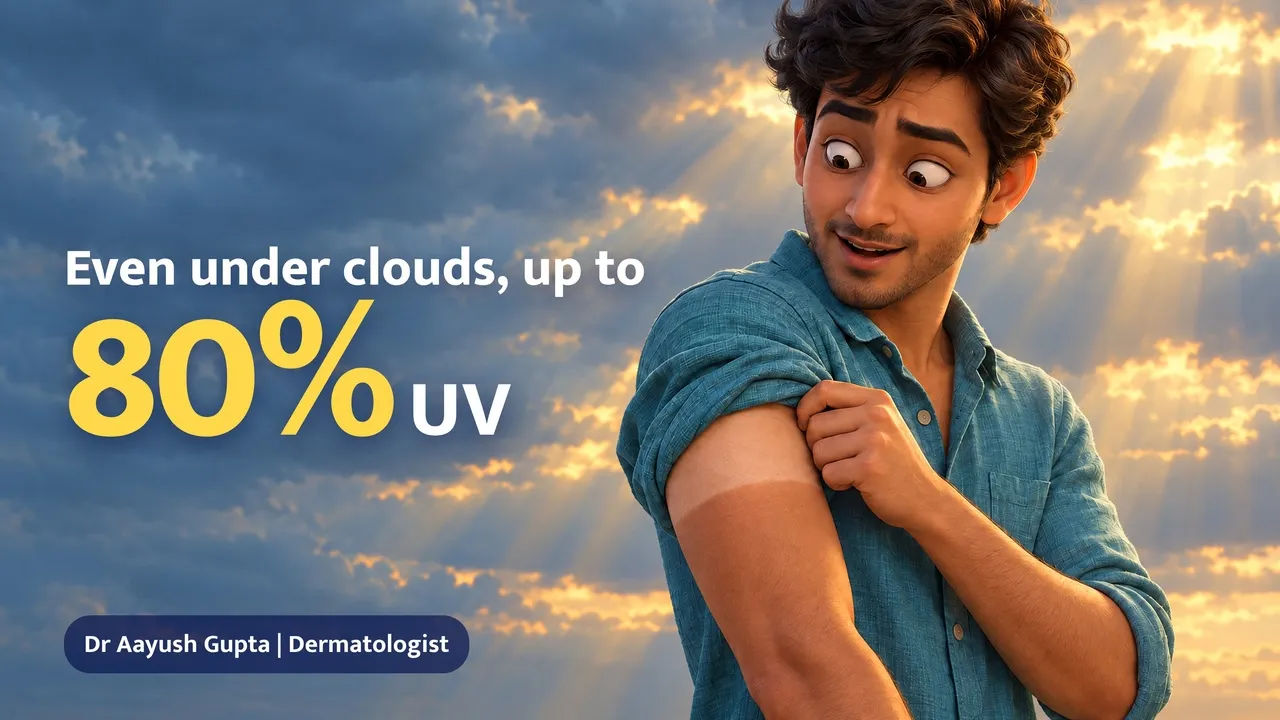
A grey sky hides the sun but lets much of its ultraviolet light (UV) through, which is how a face can look darker a few days after an overcast afternoon outdoors. This film shows where that UV comes from. Air molecules scatter UV in every direction, and even a fully grey sky can let up to 80% of it reach you. When the sun breaks through a gap, light from the bright edges of the clouds can lift UV above a clear day's level for a few minutes. The ground reflects some of it back, with dry sand returning about 15% and fresh snow up to 80%, and UV rises about 10% for every 1000 metres of altitude. Ordinary window glass stops UVB but lets much of the UVA pass, and clothing protects according to how closely it is woven. The film ends with the UV index and what to use when it reaches 3 or more.
- Reviewed by
- Dr Aayush Gupta
- Published
- 2 November 2026
- Languages
- English and Hindi
- On YouTube
- Watch on YouTube ↗
Sources
- US Food and Drug Administration, Tips to stay safe in the sun (even on an overcast day, up to 80% of the sun's UV rays can get through the clouds). fda.gov
- Silva AA. Photochem Photobiol Sci 2015 (measuring the scattered UV from the open sky at a tropical site, with the sky component at least 48% of the daily erythemal dose under a practically cloudless sky). doi:10.1039/c5pp00131e
- Silva AA. Photochem Photobiol 2018 (at one site in Brazil, cloud enhancement events made the erythemal dose rate up to 45% higher than the clear-sky summer reference for a few minutes). doi:10.1111/php.13054
- Silva AA. Photochem Photobiol Sci 2013 (under noon overcast skies at one tropical site, enhancement events lasted 2 to 7 minutes and averaged 4.5 minutes). doi:10.1039/c2pp25330e
- World Health Organization, Radiation: ultraviolet (UV) (dry sand reflects about 15% and sea foam about 25% of UV; fresh snow reflects as much as 80% and almost doubles exposure; UV rises by approximately 10% with every 1000 m of altitude). who.int
- Duarte I et al. Photodermatol Photoimmunol Photomed 2009 (in a laboratory test, all building glasses blocked UVB fully, while smooth ordinary glass transmitted 74.3% of UVA). doi:10.1111/j.1600-0781.2009.00434.x
- ARPANSA, Labelling sun protective clothing (UPF 50 lets through 1/50, or 2%, of UV). arpansa.gov.au
- ARPANSA, Sun protection clothing (fabric UPF falls with a looser weave, a lighter colour, stretching and wear). arpansa.gov.au
- Cancer Council NSW, Clothing as sun protection (hold the garment up to the light; the less light that passes through, the better it protects). cancercouncil.com.au
- Gambichler T et al. BMC Dermatol 2001 (of 236 summer fabrics tested dry and unstretched, more than 70% of wool, polyester and blends reached UPF 30 or more, against fewer than 30% of cotton, linen and viscose). doi:10.1186/1471-5945-1-6
- US Environmental Protection Agency, UV Index scale, archived January 2025 page (for an index of 3 to 7 it advises shade at midday, sunscreen, protective clothing and a wide-brimmed hat). 19january2025snapshot.epa.gov
More explainers

General health education, not medical advice for any individual. Narration uses an AI voice; the script and animation are prepared with AI assistance, then checked and approved by Dr Gupta.